Staff Paper 101: A Beginner's Guide to Music Notation
Have you ever stared at a blank page of staff paper, wondering how those lines and symbols translate into beautiful music? Where can I get free staff paper that meets your creative needs? For aspiring musicians, deciphering music notation can feel like cracking an ancient code. This comprehensive guide will demystify staff paper fundamentals while introducing you to the completely free, customizable templates at StaffPaper.org—your ultimate resource for all notation needs.
By the end of this article, you'll understand staff paper anatomy, basic notation elements, and practical applications—whether you're a student, composer, or educator.
What Is Staff Paper and Why Do Musicians Need It?
Staff paper (also called manuscript paper) is the canvas where musical ideas transform into written compositions. Unlike blank sheets, its five horizontal lines and four spaces create a universal grid for arranging notes, rhythms, and musical symbols.
The Anatomy of Staff Paper: Lines, Spaces, and Clefs
Mastering music notation begins with understanding three core components:
- Lines and Spaces: Each of the five parallel lines (and the areas between them) represents a specific musical pitch.
- Clef Symbols: Positioned at the far left, these icons (like treble clef or bass clef) determine which notes correspond to each line/space.
- Time Signature: This fraction-like symbol (e.g., 4/4) appears after the clef, specifying rhythmic structure.
Professional composers rely on specialized templates like our piano staff paper featuring grand staves—paired treble and bass clefs for simultaneous right/left-hand notation.
Beyond Standard Staff: Specialized Paper for Different Instruments
Musicians use distinct staff formats:
- Guitarists: Combine standard notation with TAB lines showing finger positions.
- Percussionists: Use unlined staves or percussion clef paper for drum patterns.
- Choral Directors: Select SATB (Soprano/Alto/Tenor/Bass) layouts with four connected staves.
At StaffPaper.org, you can generate custom formats for any instrument in seconds.

How to Read Staff Paper: Basic Notation Elements
Reading staff paper involves decoding two dimensions: pitch (vertical placement) and rhythm (horizontal symbols).
Mastering Note Reading and Placement
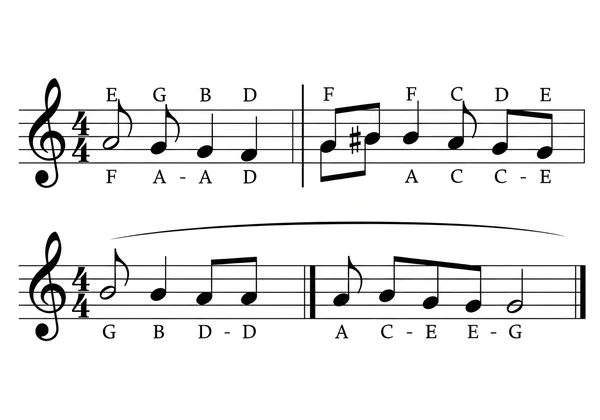
Notes sit on lines/spaces to indicate pitch. Use these mnemonics:
- Treble Clef Lines: E-G-B-D-F (Every Good Boy Does Fine)
- Treble Clef Spaces: F-A-C-E (spells "FACE")
- Bass Clef Lines: G-B-D-F-A (Good Boys Do Fine Always)
Higher notes appear higher on the staff. Middle C (the central piano note) sits on a ledger line below the treble staff or above the bass staff.
Understanding Rhythm and Time on Staff Paper
Rhythms are defined by:
- Note Shapes: Whole notes (4 beats), half notes (2 beats), quarter notes (1 beat).
- Time Signatures: 4/4 means four beats per measure; 3/4 implies waltz-like timing.
- Rests: Symbols indicating silence durations matching their note equivalents.
Need practice sheets? Download our printable rhythm exercises with free staff paper PDFs.
Getting Started with Staff Paper: Practical Applications
Staff Paper for Music Students: Practice and Assignment Tips
Maximize your studies with these strategies:
- Print 30-line practice sheets for intensive sight-reading drills.
- Use oversized staves (select fewer lines per page) for clearer note handwriting.
- Organize scales/arpeggios by key signature across multiple pages.
From Idea to Notation: Using Staff Paper for Composition
Transform melodies in your head into written music:
- Sketch rough ideas on 12-line staff paper to capture motifs quickly.
- Use brackets to connect staves when arranging multi-instrument pieces.
- Leave margin notes for dynamics (e.g., crescendos, staccato marks).
"StaffPaper.org lets me prototype string quartets without buying expensive manuscript books," notes composer Lea Rodríguez.

Your Journey into Music Notation Starts Here
Staff paper isn’t just paper—it’s a portal to musical expression. Whether you’re:
- Transcribing your first melody
- Preparing classroom worksheets
- Archiving original compositions
StaffPaper.org offers instant access to professional-grade, customizable templates. Start your free download and transform those blank lines into your next masterpiece today!
FAQ Section
Where can I get free staff paper?
Our platform provides download-ready templates in PDF format—no registration required.
How many lines are on standard staff paper?
Traditional staves have five lines, but printable sheets may contain 8-12 staves per page for efficiency.
What is the difference between staff paper and sheet music?
Staff paper is blank, while sheet music contains pre-written notation. Think of staff paper as an empty canvas versus a finished painting.
Can I create custom staff paper online?
Yes! Use StaffPaper.org’s tool to specify instruments, clefs, lines per page, and paper size (A4/Letter).
What’s the best paper for printing sheet music?
We recommend 90-120gsm matte paper for durability without glare.