Music Teacher's Toolkit: Lesson Plans & Staff Paper
As a music educator, you are constantly juggling lesson planning, classroom management, and inspiring the next generation of musicians. Finding high-quality, adaptable resources can feel like a full-time job. Are you looking for ways to streamline your preparation time while delivering more engaging and effective lessons?
This toolkit is designed to make your teaching life easier. We've created comprehensive lesson plan templates and practical ideas that integrate seamlessly with customizable staff paper. By combining structured lesson plans with the right materials, you can spend less time searching for resources and more time teaching. These ready-to-use strategies and customizable resources will help you create more engaging lessons for your students.
Music Lesson Plan Templates for Every Grade Level
Effective teaching begins with a solid plan. A well-structured lesson helps students meet their learning objectives, whether they're beginners or advanced students. The key is to have materials that are appropriate for each developmental stage.
Below, we offer music lesson plan templates designed for elementary, middle, and high school students. Each template is built to work perfectly with custom notation paper, allowing you to create a consistent and professional learning environment.
Elementary Music Education Activities with Staff Paper
In elementary school, the goal is to build a fun and strong foundation. Lessons should be interactive, hands-on, and visually engaging. Using staff paper is a fantastic way to introduce core concepts like rhythm, melody, and the music staff itself in a tangible way.
Lesson Idea: "Rhythm Story"
- Objective: Introduce quarter notes, half notes, and whole notes.
- Materials: Download and print a sheet of our large-lined staff paper with only a few staves per page, making it easy for small hands to write on.
- Activity:
- Tell a simple story, assigning a specific note value to different characters or actions. For example, a walking turtle is a whole note, a hopping rabbit is a half note, and a marching ant is a quarter note.
- Have students draw the corresponding note symbols on their staff paper as you tell the story.
- Clap the rhythms together as a class to connect the visual symbol with the sound.
- Assessment: See if students can create their own short "rhythm story" using the notes they've learned.
Middle School Music Theory Exercises Using Notation Paper
Middle school students are ready to dive deeper into music theory. They can handle more complex ideas like key signatures, time signatures, and basic chord structures. Your lesson plans should include exercises that reinforce these concepts through practical application.
Lesson Idea: "Key Signature Detective"
- Objective: Help students identify and write major key signatures.
- Materials: Use our tool to generate standard staff paper with a treble or bass clef, leaving room for students to write.
- Activity:
- Begin by teaching the "Circle of Fifths" as a tool for remembering key signatures.
- Provide students with a worksheet where they must fill in the sharps or flats for given major keys (e.g., G Major, F Major, D Major).
- For a challenge, give them a key signature and ask them to identify the corresponding major key.
- Assessment: Have students compose a simple four-measure melody in a specific key, ensuring they use the correct notes from that key's scale. This puts their theoretical knowledge into creative practice.
High School Music Curriculum Templates with Advanced Notation
High school musicians are often preparing for college auditions, participating in advanced ensembles, or exploring composition. Your curriculum should challenge them with more sophisticated topics, such as four-part harmony, counterpoint, and complex rhythmic notation.
Lesson Idea: "Voice Leading 101"
-
Objective: Introduce the basic rules of four-part chorale writing (SATB).
-
Materials: The piano grand staff is perfect for this. Generate and print custom piano staff paper for your students.
-
Activity:
- Review the basic rules of voice leading: avoid parallel fifths and octaves, keep common tones, and move other voices by the smallest possible interval.
- Provide students with a simple chord progression (e.g., I-IV-V-I) and a soprano melody line.
- Ask them to fill in the alto, tenor, and bass parts according to the rules of voice leading.
-
Assessment: Review their work for correctness, focusing on smooth voice leading and correct chord spellings. This exercise builds a critical skill for any aspiring composer or arranger.

Choir Rehearsal Templates & Organizational Systems
Choir management involves more than just leading songs. It requires meticulous planning, organization, and clear communication. From sectional rehearsals to concert preparation, having the right templates can make a world of difference. Efficient systems allow you to focus on the music and your singers' performance.
These choir rehearsal templates are designed to help you organize your time effectively and ensure every singer has what they need to succeed.
Sectional Rehearsal Planning with Custom Part Extraction
Sectional rehearsals are crucial for working on specific vocal parts, refining harmonies, and addressing trouble spots. To make these sessions productive, singers need clear, easy-to-read music for their part only. Manually creating these materials can be incredibly time-consuming.
Organizational Tip:
- Isolate Challenging Passages: Identify 8-16 measure sections of a piece where a specific voice part (e.g., altos or tenors) needs extra work.
- Create Custom Worksheets: Use a simple online tool to create blank staff paper. You can then hand-write just the specific part for that section.
- Focus the Rehearsal: Distribute these custom sheets during sectionals. This removes the distraction of other vocal lines and allows singers to focus entirely on their notes, rhythms, and dynamics. This targeted approach is far more effective than trying to isolate parts from a full score.
Concert Preparation Timelines & Staff Paper Organization
The weeks leading up to a concert can be hectic. A clear timeline and organized materials are essential for a smooth and successful performance. Integrating staff paper into your organizational system can help track progress and communicate musical details clearly.
Concert Prep System:
- 8 Weeks Out: Finalize repertoire. Create a binder for each singer with all necessary sheet music. Print extra copies of blank manuscript paper for notes.
- 6 Weeks Out: Begin intensive note-learning. Use sectional time to drill difficult passages, using the custom part-extraction worksheets mentioned above.
- 4 Weeks Out: Focus on dynamics, phrasing, and articulation. Use a sheet of blank manuscript paper to write down "performance notes" for the whole choir and distribute them. This can include reminders like "crescendo in measure 16" or "watch conductor for cutoff in measure 32."
- 2 Weeks Out: Run full rehearsals. Record the rehearsals and have students take notes on their performance.
- 1 Week Out: Dress rehearsal. Focus on stage presence, entrances, and exits. Final review of all musical notes.
Classroom Staff Paper for Diverse Teaching Scenarios
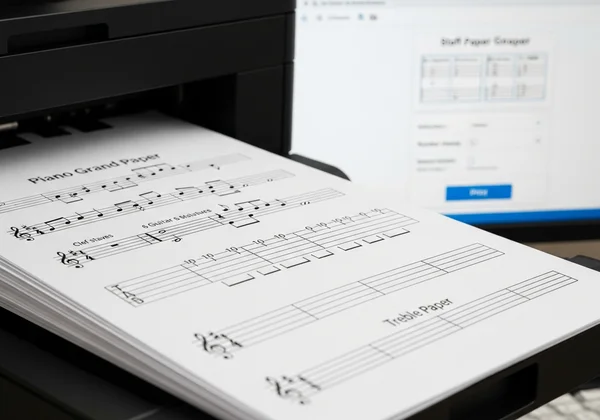
A versatile teacher needs versatile tools. A single type of staff paper won't work for every lesson. Whether you're teaching sight-reading, guiding a composition project, or assessing student progress, having the right classroom staff paper is crucial. The ability to customize staves, clefs, and layout on demand is a game-changer.
Sight-Reading Exercises with Progressive Difficulty Staff Paper
Sight-reading is a fundamental skill that builds confidence and musical fluency. The best way to teach it is through consistent practice with exercises that gradually increase in difficulty.
Implementation Strategy:
- Level 1 (Beginner): Create exercises on staff paper with a large staff size and only a few notes. Use simple rhythms within a five-note range.
- Level 2 (Intermediate): Introduce leaps, accidentals, and more complex rhythms. You can generate custom notation paper with standard staff spacing for this.
- Level 3 (Advanced): Create exercises that include key signature changes, complex time signatures, and ledger lines.
By creating your own progressive exercises, you can perfectly match the difficulty to your students' current skill level, ensuring they are challenged but not overwhelmed.
Composition Assignments: Structured Templates for Student Creativity
Composition is where students get to apply music theory in a creative, personal way. However, a blank page can be intimidating. Providing structured templates gives students a starting point and guides their creativity.
Project Idea: "Theme and Variations"
- Provide a Theme: Compose a simple, memorable 8-measure melody. Print it on the top staff of a sheet of our free staff paper.
- Set the Task: Ask students to write three variations of the theme on the staves below.
- Give Clear Guidelines:
- Variation 1 (Rhythmic): Keep the notes of the melody the same but change the rhythm.
- Variation 2 (Melodic): Keep the rhythm but change some of the notes.
- Variation 3 (Free): Change both rhythm and melody, but make sure the original theme is still recognizable.
This structured assignment empowers students to be creative within a manageable framework, building their confidence as composers.
Assessment Tools: Graded Staff Paper for Evaluating Student Progress
How do you accurately assess a student's understanding of notation? A well-designed written test is an excellent tool. Using custom staff paper for assessments ensures clarity and professionalism.
Assessment Idea: "Music Theory Quiz" Create a quiz using our online tool to generate a PDF with different sections:
- Section 1: Print staves with clefs and ask students to draw specific notes (e.g., "Draw a treble clef G on the staff").
- Section 2: Print several key signatures and have students identify them.
- Section 3: Provide short rhythmic examples and ask students to identify the time signature.
- Section 4 (Melodic Dictation): Print blank staves. Play a simple melody on the piano and have students write it down.
Using clean, computer-generated staff paper makes the quiz easy for students to read and simple for you to grade.
Start Your Next Lesson with These Time-Saving Teaching Resources
By combining structured lesson plans with the right materials, you can create more effective learning experiences for your students. From introducing basic rhythms in elementary school to guiding advanced composition in high school, the right tools make all the difference. Your ability to create customized learning experiences is your greatest strength as an educator.
Stop spending hours searching for the perfect worksheet or buying expensive notation books. Empower your teaching with a limitless supply of free, high-quality music paper.
Ready to build your next lesson plan? Visit our site to instantly generate and download the perfect staff paper for any instrument, grade level, or classroom activity.
Frequently Asked Questions About Music Lesson Planning with Staff Paper
How do these lesson plans integrate with customizable staff paper?
These lesson plans are designed to be used with specific types of staff paper. For example, a beginner piano lesson works best with a large grand staff, while a guitar composition exercise needs staff and TAB lines. By using a tool like StaffPaper.org, you can instantly create the exact format required for each activity, making the lesson more effective.
Can these templates be adapted for different class sizes?
Absolutely. The activities are designed to be flexible. For larger classes, you can perform activities like "Rhythm Story" as a group. For smaller classes or private lessons, you can provide more one-on-one guidance during composition assignments. The key is printing enough copies of the appropriate staff paper for every student.
What grade levels are covered in this music teacher toolkit?
This toolkit provides ideas and templates for all major grade levels: elementary, middle, and high school. The strategies are designed to be progressive, starting with foundational concepts for young learners and moving toward advanced theory and composition for older students. You can easily adapt the difficulty of each exercise.
How can I access the printable staff paper resources mentioned?
Accessing the resources is simple and free. Just go to StaffPaper.org, select the type of music paper you need (e.g., piano, guitar, choir), customize the number of staves and paper size, and export your PDF. There is no need to sign up or register.
Are these lesson plans aligned with music education standards?
Yes, these lesson plans are built around core concepts found in most national and state music education standards. They focus on foundational skills like rhythm, melody, harmony, sight-reading, and composition, which are central to a well-rounded music curriculum. You can easily align them with your specific learning objectives.